The tourist in Panama may cross the Canal, swim in the tropical waters of the San Blas islands, visit the Embera in the jungle, wander through the beautifully preserved Old Town of Casco Viejo and the Financial District, with its forest of skyscrapers, the densest concentration in Latin America, eat and drink superbly, listen to music, dance, and leave content. The traveler in Panama will enjoy all this too. But if, willingly or not, they possess a “third eye,” then they will feel what Claude Lévi-Strauss wrote seventy years ago in Tristes Tropiques: the loss or deformation of both indigenous peoples and nature under the pressure of the Western model of “development,” a model that once imposed itself at the social and economic level and is now consummated in climate catastrophe, whose maker, unless we choose blindness, is Western man in his dominant form.
The tourist in Panama may cross the Canal, swim in the tropical waters of the San Blas islands, visit the Embera in the jungle, wander through the beautifully preserved Old Town of Casco Viejo and the Financial District, with its forest of skyscrapers, the densest concentration in Latin America, eat and drink superbly, listen to music, dance, and leave content.
The traveler in Panama will enjoy all this too. But if, willingly or not, they possess a “third eye,” then they will feel what Claude Lévi-Strauss wrote seventy years ago in Tristes Tropiques: the loss or deformation of both indigenous peoples and nature under the pressure of the Western model of “development,” a model that once imposed itself at the social and economic level and is now consummated in climate catastrophe, whose maker, unless we choose blindness, is Western man in his dominant form.
With “three” eyes, then, and several cameras, we travelled through Panama. I will speak only of three places.
The Canal and its surrounding world
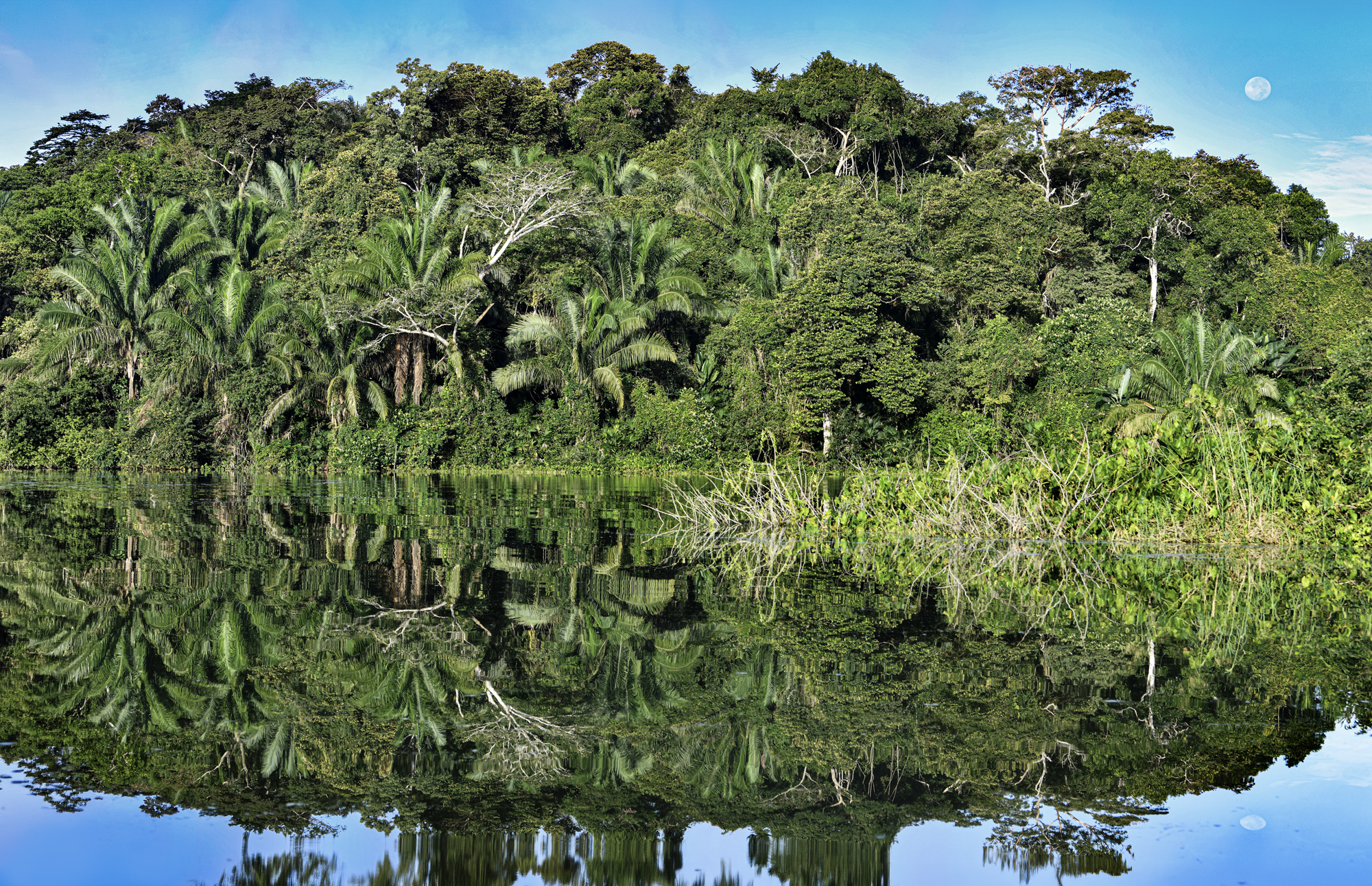
An extraordinary feat of engineering, built in 1913 to 1914, the Panama Canal undeniably transformed navigation and global trade. You feel dizzy when your small boat drifts alongside colossal tankers, or when you see them materializing like ghosts through the morning mist. You feel awe in the jungle around Gatun Lake, an artificial lake created for the needs of the Canal by damming the Chagres River. Its creation drowned entire ecosystems. Hilltops became islands, and there, in places inaccessible to humans, vegetation flourished wildly and isolated animal populations multiplied.
Until man decided to exploit even this “free space.” Monkeys and other animals were taken to Monkey Island and used in experiments on behaviour and species management. Melancholy overtakes you when you see the “disciplined” monkey waiting patiently on a branch for your boat to draw near, then leaping aboard, domesticated, to receive a treat. What you feel then is nostalgia for the wild.
The San Blas Islands and the Guna
On these islands, wild nature seems hidden beneath an idyllic surface of calm. But let us begin at the beginning.
You leave before dawn and cross neighbourhoods and urban sprawl on the outskirts of Panama City so degraded that it is hard to believe they exist behind the polished scenery of the Old Town and the Financial District. Perhaps Santa Ana and El Chorrillo are such places, districts the police politely but firmly forbade us to enter. Zones built to absorb poverty: the wild nature of cities.
After about two hours, we entered Guna Yala, the autonomous territory of the Guna, a strip of tropical forest stretching toward Colombia together with the San Blas archipelago. It is one of the few autonomous Indigenous territories in Latin America, with its own local government, its own flag, its own language, Dulegaya, and even passport control. The Guna won this autonomy after an uprising in 1925.
We drove along a narrow road through the jungle of the Cordillera de San Blas, a route of almost inconceivable bends, climbs, and descents. We were told that the Guna deliberately keep it in this condition to protect themselves from intrusion. We admired the beauty of untamed, unviolated nature. After some hours we reached the port of Carti and boarded the boats that would take us to the islands. At the port we saw shacks, but paid them no attention.
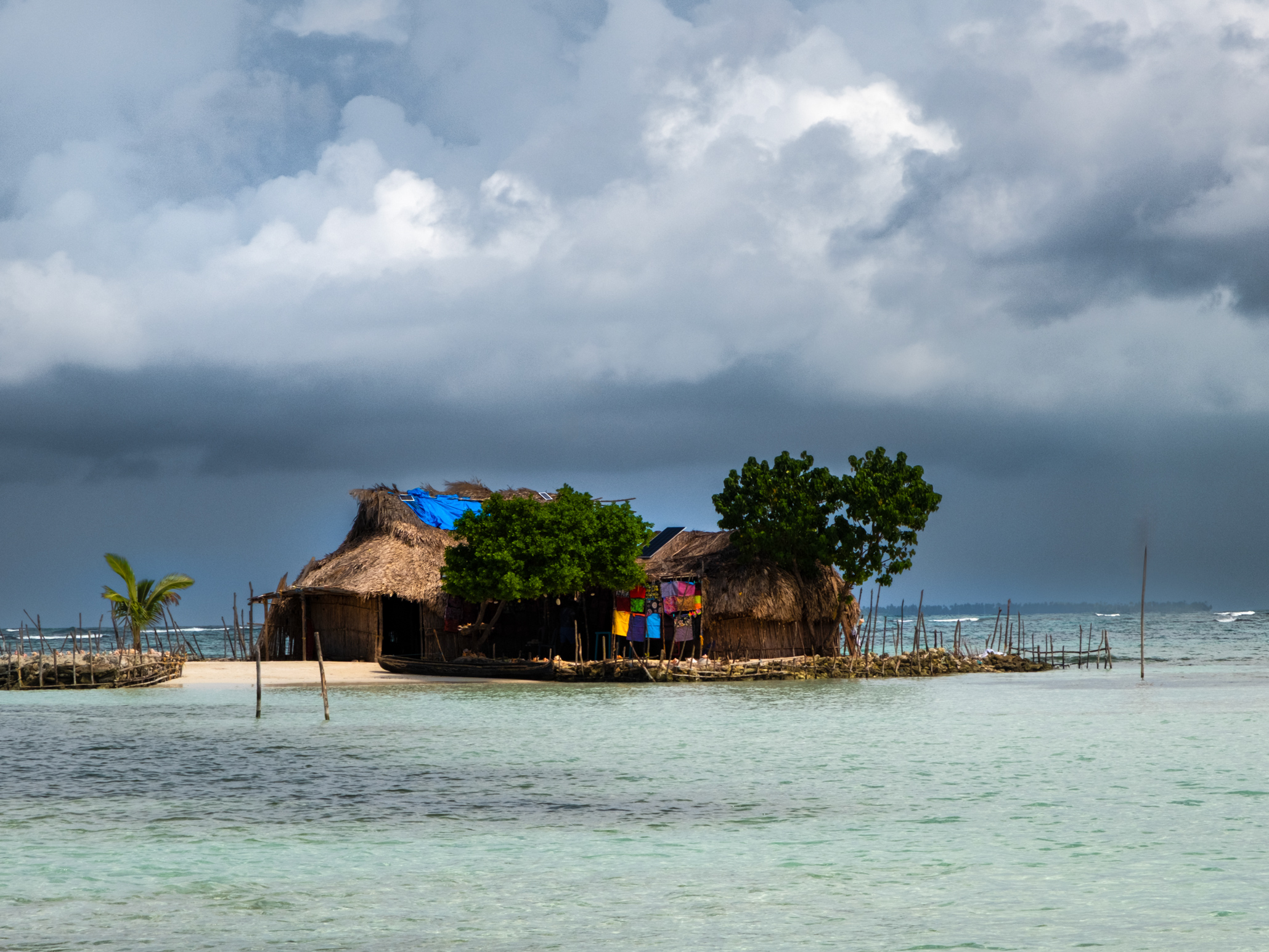
The “third eye” had closed. Our innocent eyes delighted in the beauty of the scattered coral islands opening before us. There are around 365 of them; 45 to 50 are inhabited, and only a few are accessible to tourists. They are small, some scarcely more than sandbanks, with a handful of palm trees, rising only a few centimetres to one metre above sea level.
We swam in blue water, ate fried fish with pineapple and papaya. We admired the painted cloths, the women’s handwork. They looked at us gravely, making no effort to charm or entice us into buying. The man steering the boat, with whom I had begun to speak, the only person among the tourists whom I treated as a human being rather than as a mere extension of the boat, responded to my interest with interest of his own. In broken English but with great warmth, he tried to explain that the patterns were symbols from the history of his people, now forgotten, like their religion itself: memory disappearing together with language, ritual, and place.
Our conversation turned to the climate crisis. The “third eye” opened.
The islands lie in a kind of shallow lagoon. Rising sea levels, hurricanes, and ever larger waves will one day swallow them. Before that happens, the pollution of the sea is already killing the coral day by day, the living tissue on which the islands themselves depend. And life built upon a corpse becomes precarious.
Yet my friend seemed calm. I thought that his animist faith, with its unbroken continuity between life and death, perhaps protected him from the death-anxiety of Western man. He pointed toward the horizon, toward the tiny private island where he lives with his dog. I thought of him as Robinson Crusoe, not Defoe’s Crusoe, who civilizes Friday, but the Crusoe reimagined by Michel Tournier: freed from Western civilization, open to nature, transformed in Friday, or, The Other Island. He said to me, “When you come back, we’ll go there,” and we agreed as though such a return might truly happen.
Melancholically, I thought of Tournier’s “The End of Robinson Crusoe,” in which the hero returns to the Pacific only to find he can no longer recover it, either because it has changed, or because the sea has swallowed it.
Only then did I understand the shacks at the port. He confirmed that they belonged to people whose islands, and all their possessions, had already been lost, and who now live there until they are relocated in order to survive in Panama City, that great crucible of the dispossessed populations of the Caribbean.
As we were leaving, he wanted to teach me a few words of his language. I thought that through them he wanted to bring me into contact with his deepest being, his mother tongue. I looked once more at the serene beauty of the archipelago and at the destruction to come, and I thought: the Guna, a brave people of some ninety thousand souls, may disappear together with their land, without ever surrendering what they are.
Gatun Lake and the Embera
We set out again in another direction, passing through a similar threshold beyond the city, and for hours we travelled through deforested areas before reaching the forests and lake landscape of Gatun, where small Embera communities live. This time we had a private guide who spoke good English and had studied sociology. During the long drive he praised the wonderful life of the Embera: no anxiety about tomorrow, directly connected to nature, which provides everything they need, food, medicine, all of it. Paradise.
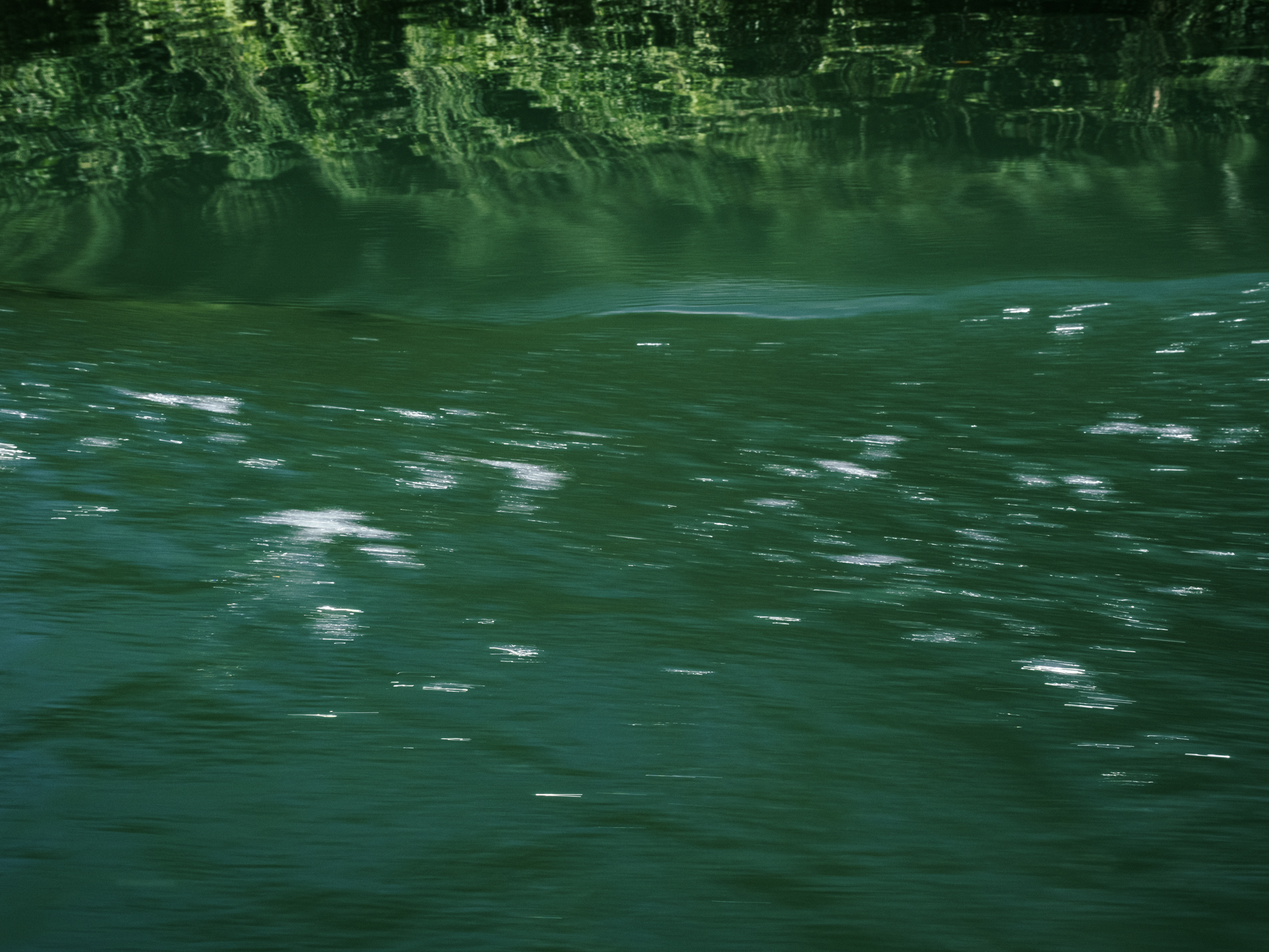
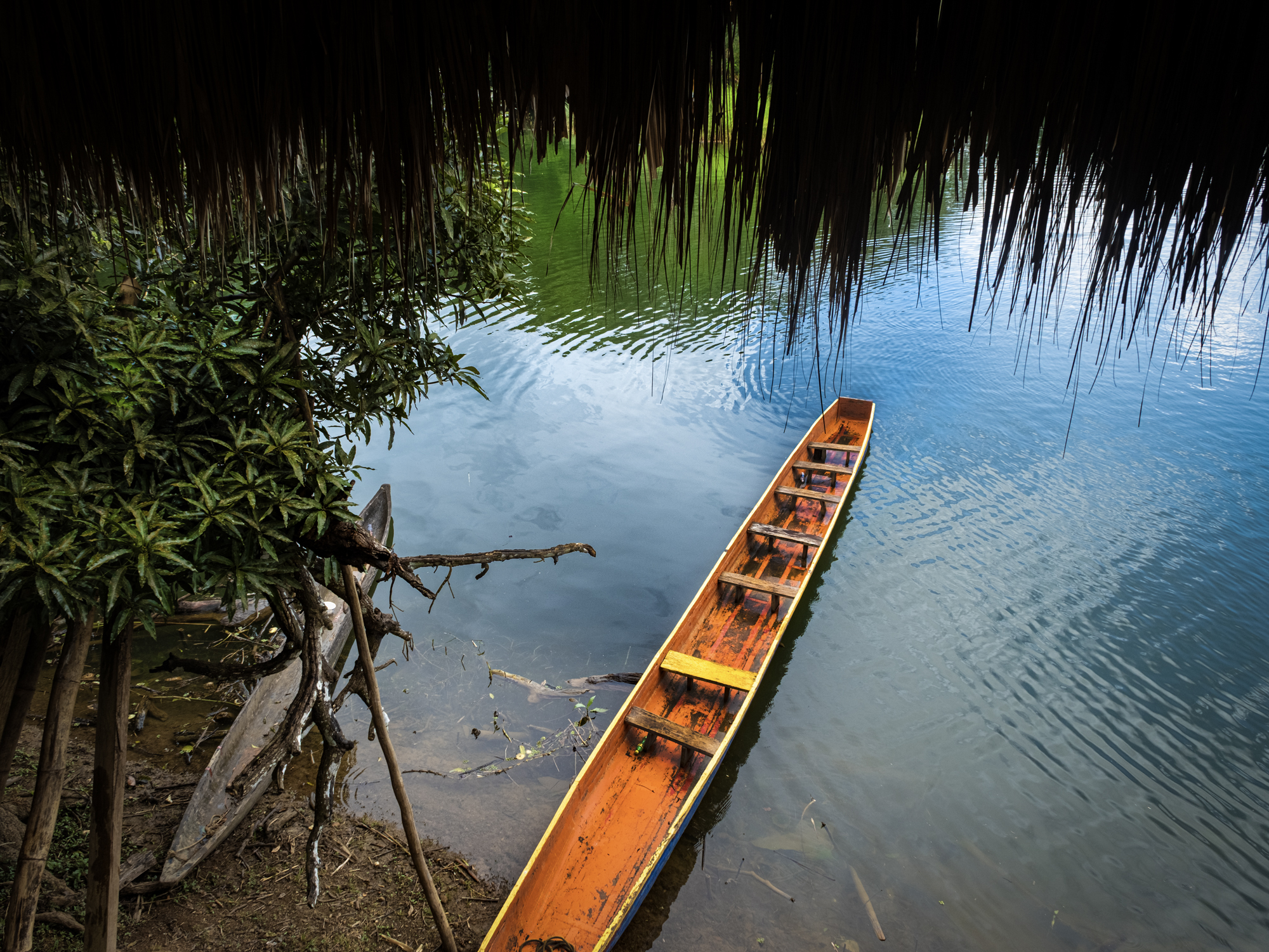
When we reached the lake, we boarded dugout canoes, steered by Embera men whose bodies were marked with intricate designs in dark ink. The landscape was so beautiful that it closed the “third eye” and opened the senses instead. The ear delighted in birdsong, the skin in the cool humidity. We moved along a river that grew narrower and narrower until the towering trees leaned toward one another overhead and formed a vault. We left the boats and continued on foot through a corridor of deepening shadow, where the movement behind the trees grew steadily more unsettling. We were walking toward the heart of darkness.
And then, suddenly, an opening: a magnificent waterfall, with iridescent blue butterflies fluttering around it. We plunged into its pool.
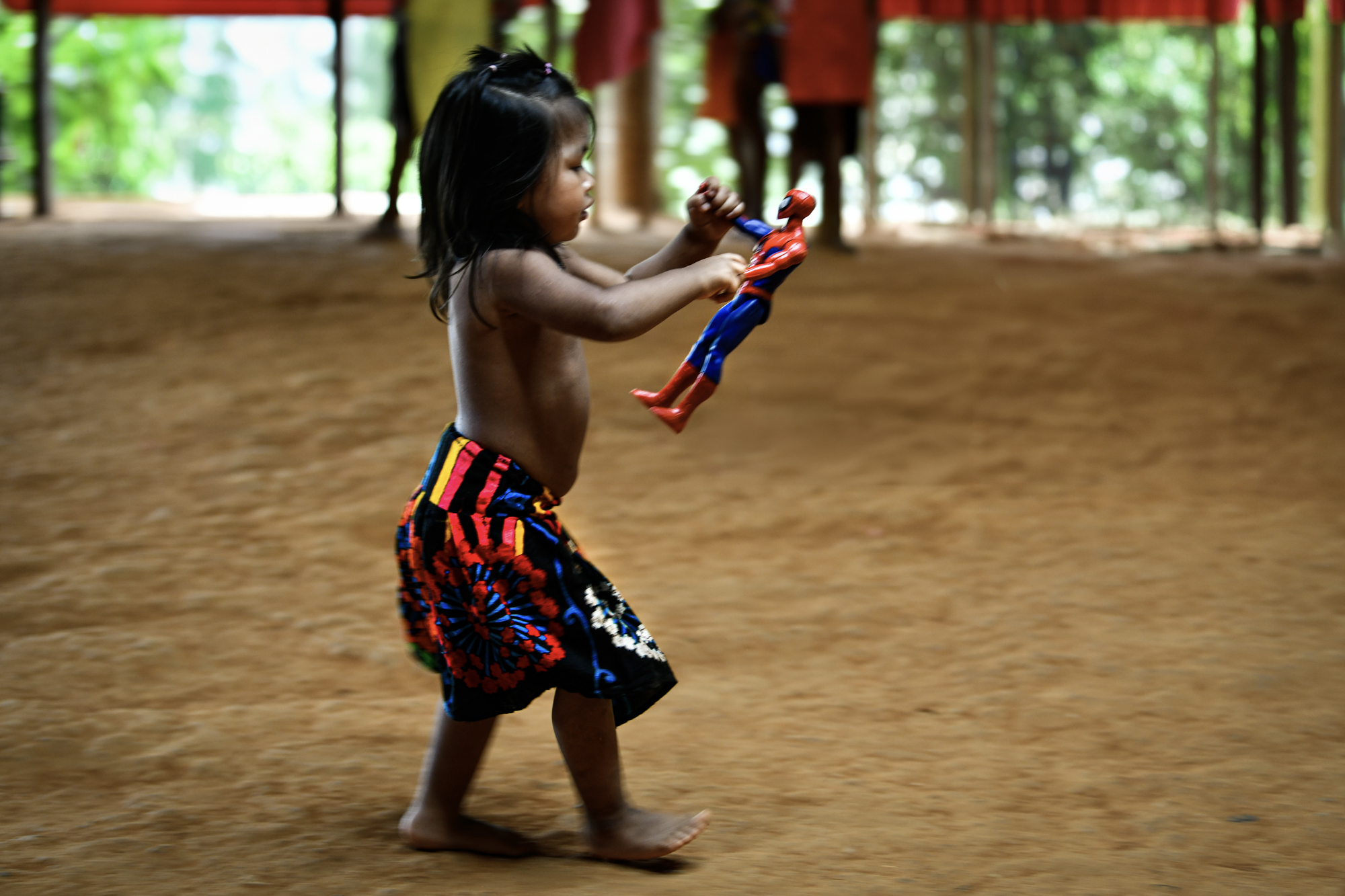
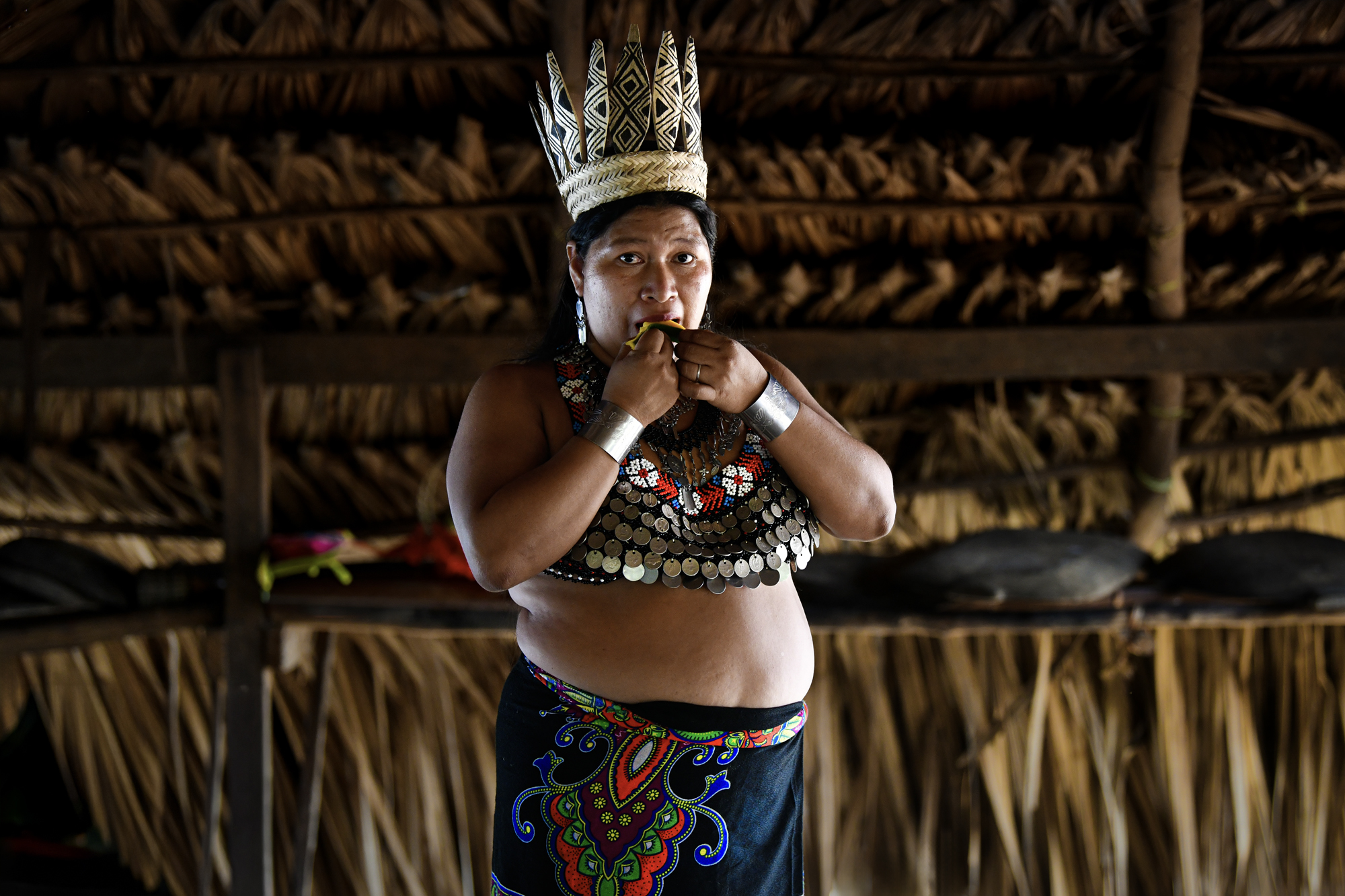
Then back to the boats. Then arrival at the village, where young men and women dressed in traditional clothes welcomed us. They offered us food; the women danced their traditional dances accompanied by a small male orchestra; they showed us their crafts. They were unfailingly polite, cheerful, ready to take selfies with delighted tourists. Seductive.
The absence of elderly Embera intensified my feeling that we were taking part in a carefully staged performance. I asked our guide about this, and he replied that the elders did not agree with this “evolution.” With that question, a door opened between us. He stopped repeating the narrative of paradise, and as we moved deeper into the village, with permission, we learned that the younger people too were divided.
Opening themselves to tourism brings them a monthly income equal to what they would earn at the nearest cement factory, where within a few years they would destroy their health. Yet some, unwilling to accept this compromise, leave and move deeper into the jungle, where hidden communities still remain.
Contact with tourists is also a health threat. On the one hand, the Embera are exposed to microbes and viruses previously unknown to them; on the other, because of their religious beliefs, they refuse vaccination. For them, Mother Earth is the god and creator of the world, and only what she gives is good.
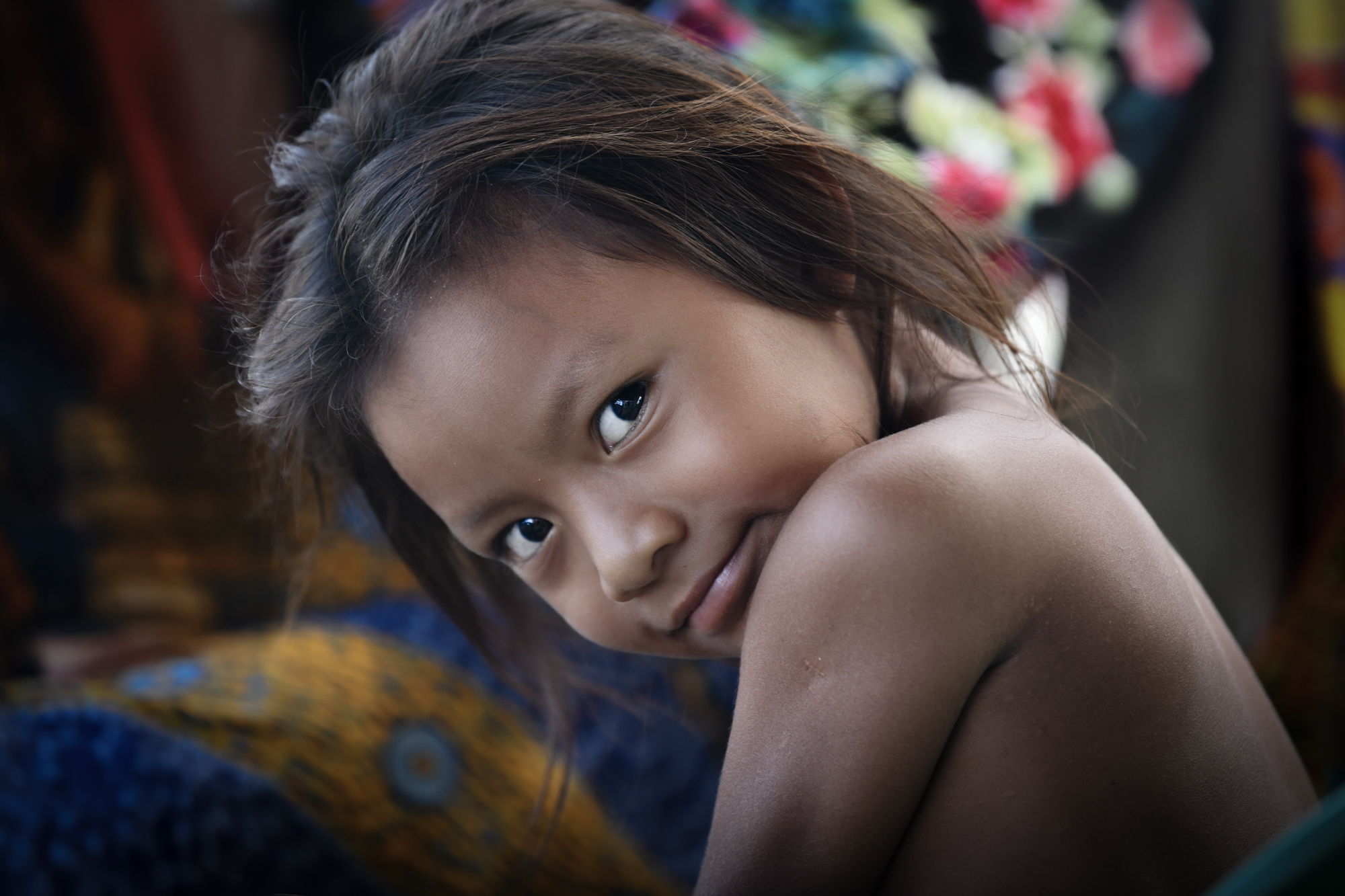
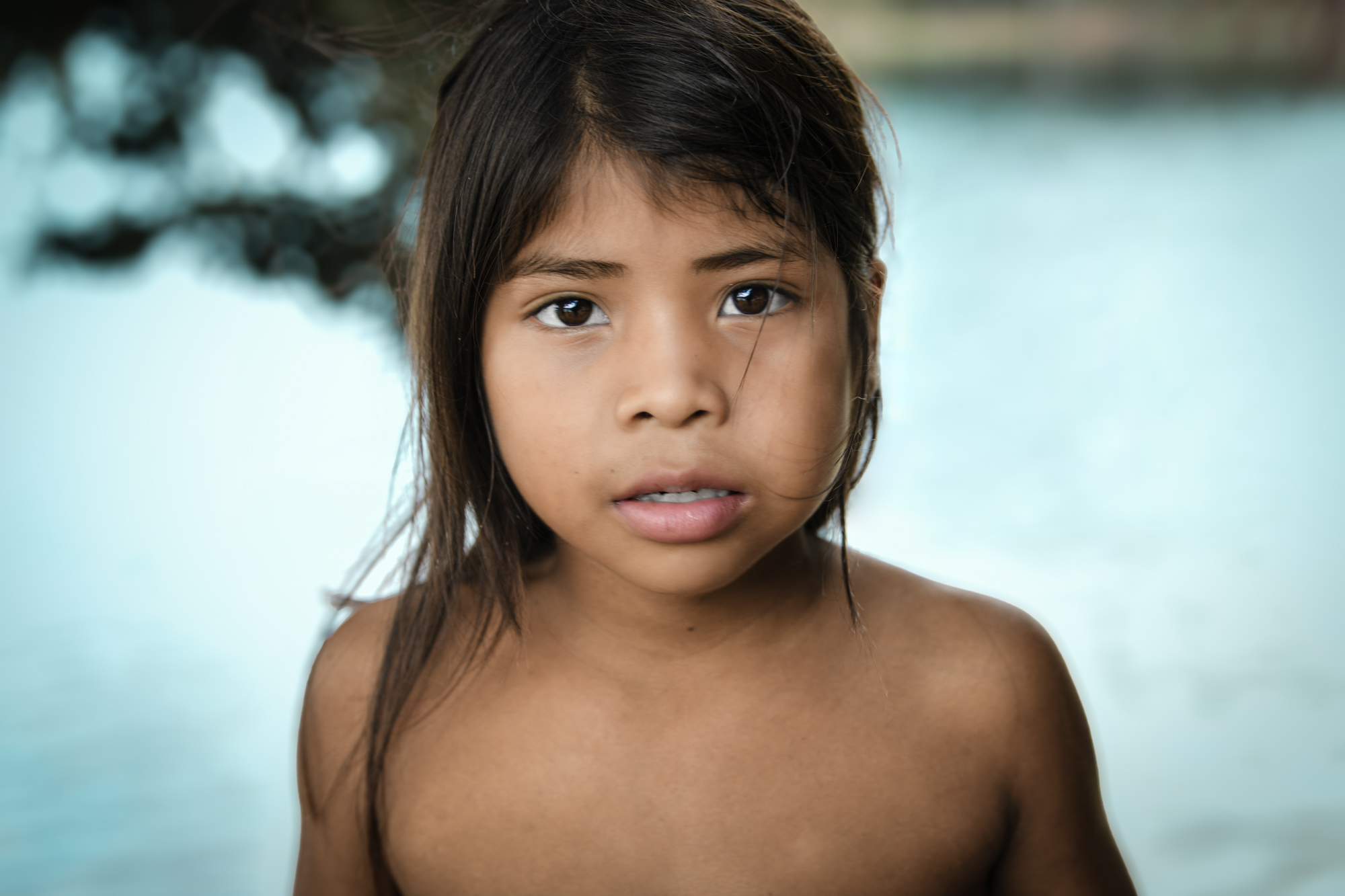
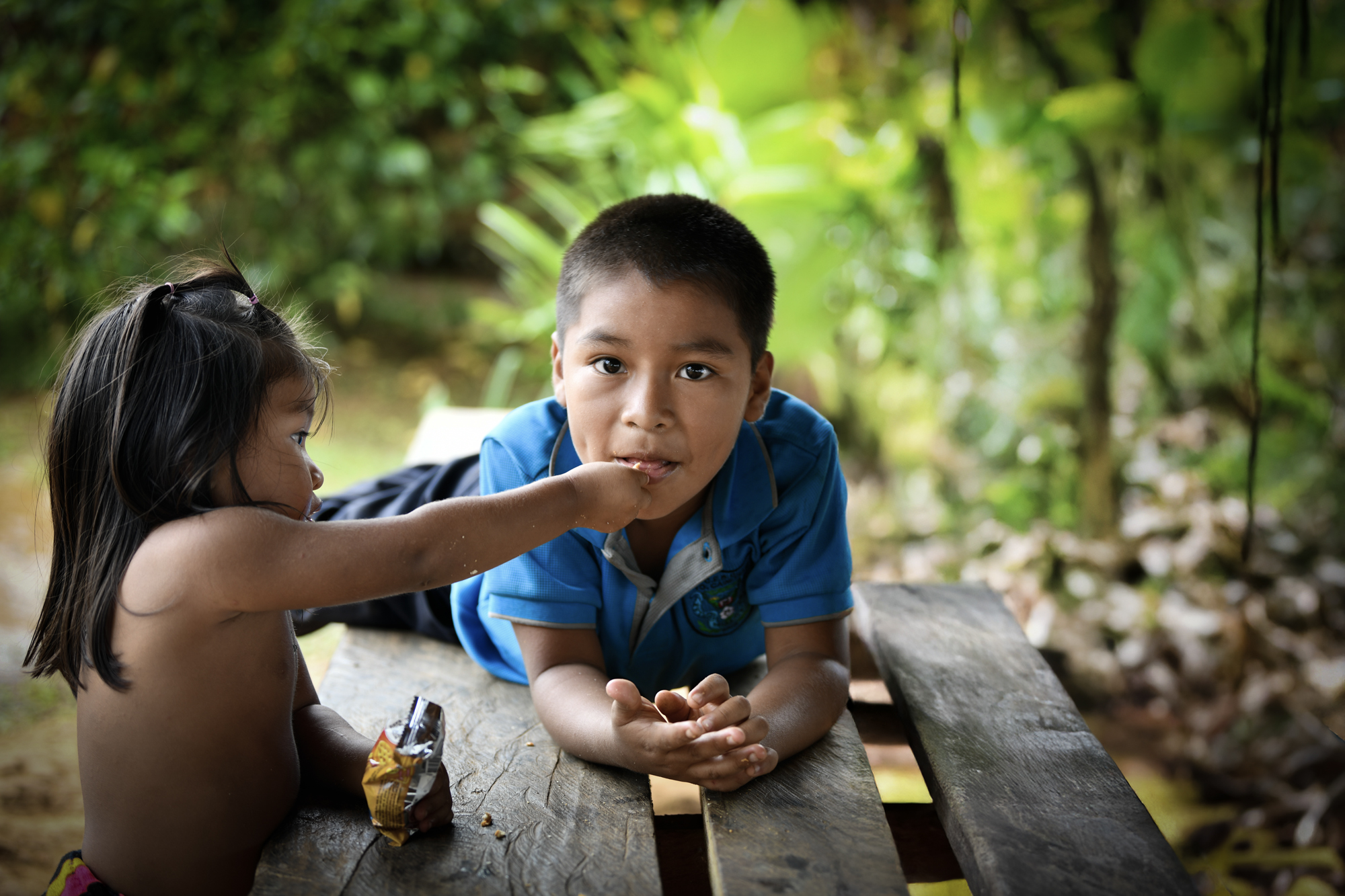
At the same time, the erosion of their world is already visible: the women are overweight; the children persistently beg tourists for sweets, and the tourists feed them as though they were animals in a zoo.
That thought led me to ask about the Embera’s political status. I learned that the area has been designated protected land, and that they no longer hold property rights over their homes or territory. They have effectively been granted the right to remain there only as “primitives.”
I thought of the cultural shock the Embera must have undergone in moving from the cyclical time of nature-bound societies into the linear time of Western modernity. Suddenly I remembered something I had once read in Émile Benveniste’s work on general linguistics: that many so-called primitive societies do not possess a verb meaning “to live.” I asked the guide about this, and although he knew their language well, he discovered with agitation that indeed there was no such verb or expression. There was, however, a word for “dead.”
Our conversation turned to burial customs, which, as Georges Dumézil observed, are among the oldest and most enduring in every civilization. The guide led us near a typical house: a vast wooden hut, perhaps a hundred square metres in size, raised on stilts. Beneath it, in the open lower level, were tools, stacked wood, food, and other necessities. He pointed to the ground.
“Here,” he said, “under the house, the Embera used to bury their dead. They wanted them close, because they believed them to be benevolent spirits who protected them. Now the state forbids it. They must cross the lake and bury their dead in the municipal cemetery. Beyond the unbearable economic cost, the Embera feel alone without their dead.”
All three of us were moved by the loneliness of our beloved dead.
We left. And on the road back, I thought that unlike the Guna, who may disappear because their land will disappear, the Embera may disappear within their own land, as it is turned into a set, a stage, where they themselves are cast as actors performing the fiction of their own lives.
Except for the few who will retreat deeper into the jungle.
Except for the few children who cross the lake every day to go to school. Those children, when they grow up, will likely leave for the city. And perhaps they will preserve, intact within themselves, the customs and traditions of their people as necessary forms of identity against the impersonality of urban life.
If I could speak again to Claude Lévi-Strauss, whom I once met at the École Pratique, I would say to him this: in Panama, tribes and nature under pressure are being driven toward the polished city, where, if one chooses to listen, the sorrow of the tropics still smoulders beneath the surface.